
What Tests Are Used to Diagnose Peripheral Neuropathy?
Not Sure Where to Start?
Choose the description that best matches what you’re experiencing:
🔥 My feet burn → Why Do My Feet Burn at Night?
👣 My feet are numb → What Causes Numbness in My Toes?
⚖️ I’m losing my balance → Can Peripheral Neuropathy Affect My Balance?
🚶 I keep tripping → Why Do I Keep Tripping? Could Peripheral Neuropathy Be the Cause?
💪 My legs or feet feel weak → Can Peripheral Neuropathy Cause Muscle Weakness?
🔍 I want to know how neuropathy is diagnosed → You’re in the right place. Keep reading.
What You’ll Learn
In this chapter you’ll discover:
- Why there is no single test for every type of neuropathy
- What happens during a neurological examination
- What blood tests may help identify underlying causes
- What EMG and nerve conduction studies evaluate
- Why someone can have neuropathy even when certain tests are normal
- When specialized tests such as skin biopsy may be considered
- Why identifying the cause can be just as important as confirming the neuropathy
Quick Answer
When patients come to my office with burning, numbness, tingling, weakness, or balance problems, one of their first questions is often:
“Doctor, is there a test that will tell me whether I have neuropathy?”
The answer is:
Yes—but it usually isn’t just one test.
Peripheral neuropathy is not a single disease.
It is a broad term describing damage or dysfunction involving peripheral nerves.
Different types of nerves may be affected.
Different medical conditions may cause the problem.
And different types of neuropathy may require different methods of evaluation.
That’s why diagnosing neuropathy often resembles putting together a puzzle.
No single piece tells the whole story.
The Most Important Test May Begin With a Conversation
Modern healthcare has extraordinary technology.
But one of the most valuable diagnostic tools remains remarkably simple:
Listening to the patient.
I want to know:
- When did your symptoms begin?
- Where did they begin?
- Did they start in both feet?
- Are they progressing?
- Do your feet burn?
- Are they numb?
- Do they feel cold even when they’re warm?
- Do you feel like you’re walking on rocks?
- Are you losing your balance?
- Are you tripping?
- Have you developed weakness?
- Are symptoms worse at night?
The pattern matters.
For example, symptoms that begin gradually in the toes of both feet and slowly move upward may suggest something very different from sudden numbness affecting one leg.
Your story helps determine which tests make sense.
The Neurological Examination
A neurological examination can provide valuable information about how your nerves are functioning.
Depending on the patient, this may include testing:
- Light touch
- Vibration
- Temperature sensation
- Pinprick sensation
- Reflexes
- Muscle strength
- Coordination
- Balance
- Walking pattern
We may also look at whether sensation changes from one part of the foot or leg to another.
These patterns can provide important clues about which nerves may be involved.
Why We Test Different Types of Sensation
Not all sensory nerves do exactly the same job.
Some nerve fibers help you detect:
- Vibration
- Pressure
- Position
Others are involved in:
- Pain
- Temperature
- Burning sensations
This distinction matters because different neuropathies may affect different nerve fibers.
A patient may therefore have significant burning pain even though some types of sensation remain relatively normal.
That brings us to an important concept.
Large-Fiber and Small-Fiber Neuropathy
Peripheral nerves contain nerve fibers of different sizes and functions.
Large nerve fibers
Large fibers are important for things such as:
- Vibration
- Position sense
- Reflexes
- Motor function
When these fibers are affected, patients may develop numbness, balance problems, reduced reflexes, or weakness.
Small nerve fibers
Small fibers are involved in functions including:
- Pain
- Temperature
- Certain autonomic functions
Small-fiber neuropathy may cause:
- Burning
- Stinging
- Pins and needles
- Electric sensations
- Abnormal sensitivity to touch
- Temperature disturbances
And this leads to something patients frequently find confusing:
Some people with small-fiber neuropathy can have normal routine nerve conduction studies.
A normal test does not always mean:
“There is nothing wrong with your nerves.”
It may mean we need to ask a different question—or use a different test.
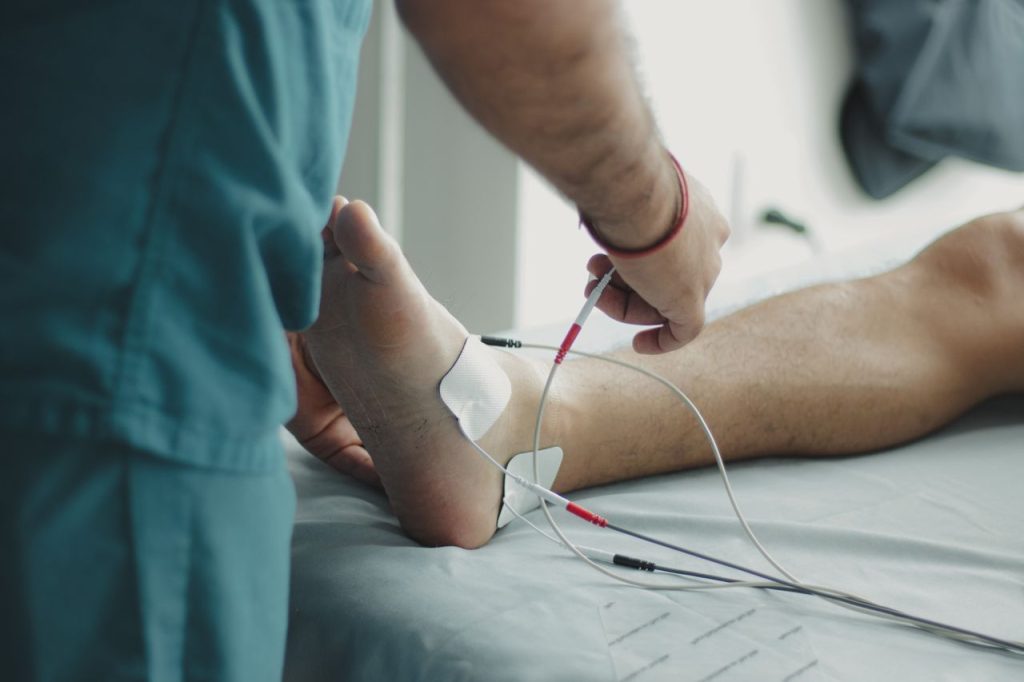
What Is a Nerve Conduction Study?
A nerve conduction study, often abbreviated NCS, measures how electrical signals travel through selected peripheral nerves.
Small electrical impulses are applied to a nerve, and the response is measured.
This can help determine whether certain nerves are conducting signals normally and may provide information about:
- Which nerves are affected
- Whether the problem appears primarily related to the nerve fiber or its insulating covering
- The distribution of nerve involvement
- The severity of abnormalities in the nerves tested
Nerve conduction studies are often performed together with an EMG.
What Is an EMG?
EMG stands for electromyography.
During a needle EMG, a small needle electrode is inserted into selected muscles to evaluate their electrical activity.
This can help clinicians investigate conditions involving:
- Nerves
- Nerve roots
- Muscles
- Certain neuromuscular disorders
An EMG may sometimes help distinguish peripheral nerve problems from conditions such as a pinched nerve coming from the spine.
Does an EMG Diagnose Every Neuropathy?
No.
This is an important point.
Standard electrodiagnostic testing primarily evaluates larger nerve fibers.
Someone with predominantly small-fiber neuropathy may have significant symptoms despite relatively normal nerve conduction studies and EMG findings.
That’s why test results must always be interpreted in the context of the patient’s symptoms and examination.
What About a Skin Biopsy?
In selected patients with suspected small-fiber neuropathy, a physician may recommend a skin biopsy.
This involves removing a very small sample of skin, which can then be examined to assess the density of small nerve fibers.
A reduced nerve fiber density can provide objective evidence supporting a diagnosis of small-fiber neuropathy.
Skin biopsy is not necessary for every patient.
But it can be valuable in the right clinical situation.
What Blood Tests May Be Used?
Once neuropathy is suspected or identified, another important question becomes:
Why is it happening?
Depending on your history, symptoms, and medical conditions, laboratory testing may be used to investigate potential causes.
Testing may include evaluation for problems involving:
- Blood sugar regulation and diabetes
- Vitamin B12 deficiency
- Thyroid function
- Kidney or liver function
- Blood cell abnormalities
- Abnormal proteins in the blood
- Nutritional deficiencies
Additional testing may be appropriate when autoimmune, infectious, toxic, hereditary, or other less common causes are suspected.
The appropriate tests vary from patient to patient.
A giant panel of laboratory tests is not automatically better medicine.
The testing should make sense for the individual.
Why Medication and Supplement History Matters
Patients sometimes forget that medications and supplements are part of their medical history.
Certain medications can contribute to neuropathy.
Chemotherapy is a well-known example, but other drugs may sometimes contribute as well.
Supplements also matter.
For example, vitamin B6 is important for normal nerve function, but excessive supplemental B6 can itself cause peripheral neuropathy.
That’s why I encourage patients to bring a complete list of:
- Prescription medications
- Over-the-counter medications
- Vitamins
- Supplements
- Energy products
More is not always better.
When Is Imaging Helpful?
An MRI or other imaging study does not usually diagnose peripheral neuropathy itself.
But imaging may be useful when symptoms suggest another problem.
For example, if someone has:
- Back pain
- Neck pain
- Symptoms predominantly on one side
- Pain radiating down an arm or leg
- New weakness
- Possible nerve root compression
imaging may help evaluate the spine or another anatomical structure.
This can be especially important because a pinched nerve and peripheral neuropathy can sometimes produce similar symptoms.
And some patients can have both.
What About Circulation Testing?
Not every numb or cold foot is caused by neuropathy.
Poor circulation can sometimes produce symptoms that overlap with nerve problems.
If the history or examination raises concern about blood flow, additional vascular evaluation may be appropriate.
Again, this is why I don’t like beginning with the assumption:
“Numb feet equal neuropathy.”
We need to understand the whole picture.
What If All My Tests Are Normal?
This can be incredibly frustrating.
A patient may think:
“If the test is normal, does that mean this is all in my head?”
Absolutely not.
A test only measures what that particular test was designed to measure.
No medical test evaluates every nerve fiber, every possible cause, and every possible neurological condition.
Normal results may be reassuring in some circumstances.
But persistent symptoms still deserve thoughtful clinical interpretation.
Sometimes additional evaluation is appropriate.
Sometimes another specialist needs to become involved.
The goal is not to keep ordering tests endlessly.
The goal is to make sense of the entire picture.
What Does “Idiopathic Neuropathy” Mean?
Some patients eventually hear the term:
Idiopathic peripheral neuropathy.
“Idiopathic” essentially means that no specific cause has been identified despite appropriate evaluation.
That can be frustrating because people naturally want to know:
“Why did this happen to me?”
Not every case provides a satisfying answer.
But even when the exact cause remains uncertain, there may still be important steps involving:
- Symptom management
- Foot protection
- Balance
- Strength
- Fall prevention
- Exercise
- Nutrition
- Management of other health conditions
Not knowing everything does not mean we can do nothing.
How We Evaluate Neuropathy at Advanced Integrated Medical
At Advanced Integrated Medical, our goal is not simply to place a label on your symptoms.
We want to understand:
What are you feeling?
What pattern does it follow?
How is it affecting your life?
What may be contributing to it?
What needs further investigation?
Depending on your individual situation, we may evaluate:
- Sensation
- Strength
- Reflexes
- Balance
- Walking
- Joint and spinal function
- Foot mechanics
- Circulation
- Medical history
- Medication and supplement history
- Previous laboratory studies
- Previous imaging or neurological testing
And when additional testing or another specialist is appropriate, referral can be an important part of good care.
Sometimes the smartest thing a doctor can do is recognize when another set of eyes is needed.
About Dr. Dee
Dr. D. Scott (“Dee”) Stevens has spent nearly four decades helping patients with peripheral neuropathy, chronic pain, musculoskeletal disorders, sports injuries, and regenerative medicine.
Throughout his career, he has cared for patients from all walks of life—including professional, collegiate, and Olympic athletes, professional football players, Major League Baseball players, professional boxers, and MMA fighters.
One lesson has remained consistent throughout those years:
Good treatment begins with a good diagnosis.
His approach emphasizes listening carefully, examining thoughtfully, educating patients about what their findings mean, and helping them determine the most appropriate next step.
Dr. Dee’s Clinical Pearl
Patients sometimes arrive carrying a stack of test results.
They’ll hand them to me and say:
“Everything says I’m normal, but I know my feet aren’t normal.”
I believe them.
Tests are incredibly valuable.
But tests don’t experience your symptoms.
You do.
My job is to consider both.
Sometimes the test gives us the answer.
Sometimes your history gives us the clue that tells us which test we should order next.
Good healthcare requires both science and listening.
Dr. Dee’s Office Conversation
Patient: “Doctor, my EMG was normal. My doctor told me everything looked fine. Why are my feet still burning?”
Dr. Dee: “A normal EMG can be useful information, but it doesn’t evaluate every type of nerve fiber. Let’s look at your symptoms, examination, medical history, and what was actually tested. A normal result answers one question. It doesn’t necessarily answer every question.”
Facing One of the Biggest Fears
“I’m Afraid They’ll Tell Me Nothing Is Wrong.”
This fear is especially common among people who have experienced symptoms for months or years without an explanation.
They begin questioning themselves.
“Maybe I’m exaggerating.”
“Maybe I’m imagining it.”
“Maybe no one believes me.”
You don’t need an abnormal test result to prove that your experience matters.
At the same time, responsible healthcare requires us to remain open-minded about the cause.
Your symptoms are real.
Our job is to investigate them carefully—not force them into a predetermined diagnosis.
Patient Success Principle #9
Don’t Chase a Test—Chase Understanding
It’s easy to believe that one MRI, one blood test, or one nerve study will finally explain everything.
Sometimes it does.
Often it doesn’t.
The real goal isn’t collecting abnormal test results.
The goal is understanding:
- What is happening
- What may be causing it
- What needs attention
- What can be improved
- What should be monitored
A test is a tool. Understanding is the goal.
Ask Dr. Dee
“Doctor, what’s the best test for neuropathy?”
There isn’t one best test for everyone.
The appropriate evaluation depends on your symptoms and the type of neuropathy being considered.
For some patients, the history and neurological examination provide strong evidence.
Others may benefit from blood testing, nerve conduction studies and EMG, specialized small-fiber testing, imaging, or additional medical evaluation.
The better question is:
“Which test will help answer the question we’re trying to solve?”
That’s the question I prefer.
Lesson I’ve Learned in 40 Years
The Patient Is More Than the Test Result
I’ve seen abnormal tests in people who function remarkably well.
And I’ve seen people struggling tremendously despite tests that appeared relatively reassuring.
Over nearly four decades, I’ve learned never to treat a piece of paper instead of the person sitting in front of me.
Tests matter.
Imaging matters.
Laboratory values matter.
But they are pieces of the puzzle.
The patient is the whole picture.
The Hope Principle
Sometimes hope comes from finally receiving an answer.
But sometimes it comes from realizing that the investigation isn’t finished.
A normal test isn’t always a dead end.
An uncertain diagnosis isn’t always the end of the journey.
And even when the exact cause cannot be identified, there may still be meaningful opportunities to improve:
- Safety
- Strength
- Balance
- Sleep
- Activity
- Symptom management
- Foot protection
- Quality of life
Hope doesn’t require pretending we know everything.
Sometimes hope simply means:
We understand more today than we did yesterday—and we know what question to ask next.
“I believe the best healthcare decisions are made when patients understand their condition. My job isn’t simply to treat symptoms—it’s to help you understand why they’re happening and what your options are.”
— Dr. D. Scott (“Dee”) Stevens
Frequently Asked Questions
Is there one test that confirms peripheral neuropathy?
No. Diagnosis usually combines medical history, neurological examination, and selected testing based on the suspected type and cause of neuropathy.
What does an EMG test for?
Needle electromyography evaluates electrical activity in selected muscles and is commonly performed along with nerve conduction studies to investigate nerve, nerve-root, muscle, and neuromuscular problems.
Can I have neuropathy with a normal EMG or nerve conduction study?
Yes. Standard electrodiagnostic studies primarily evaluate larger nerve fibers. Small-fiber neuropathy may not be detected by routine nerve conduction testing.
What test can diagnose small-fiber neuropathy?
Depending on the clinical situation, specialized testing such as skin biopsy to measure small nerve fiber density may be considered. Other specialized autonomic or sensory testing may also be used in some settings.
What blood tests should I have?
That depends on your medical history and symptoms. Common evaluations may investigate blood sugar, vitamin B12, thyroid function, kidney and liver function, blood abnormalities, and other potential causes. Additional testing should be individualized.
Does an MRI show peripheral neuropathy?
Generally, MRI is not used to directly diagnose typical peripheral neuropathy. It can be helpful when a spinal problem, nerve compression, or another structural condition is suspected.
What if doctors cannot determine the cause?
Some neuropathies remain idiopathic despite appropriate evaluation. That doesn’t mean your symptoms aren’t real or that nothing can be done to support function, safety, and quality of life.
Key Takeaways
- There is no single test that diagnoses every type of peripheral neuropathy.
- Your medical history and neurological examination are important parts of the diagnostic process.
- Nerve conduction studies and EMG are useful but do not detect every type of neuropathy.
- Small-fiber neuropathy may require different testing.
- Laboratory testing may help uncover treatable or manageable underlying causes.
- Imaging may be appropriate when spinal or structural problems are suspected.
- Normal test results do not automatically mean your symptoms aren’t real.
- The ultimate goal isn’t simply diagnosing neuropathy—it’s understanding why you have it.
Why Patients Choose Advanced Integrated Medical
At Advanced Integrated Medical, we believe testing should answer questions—not simply generate numbers.
We begin by listening.
We want to understand your symptoms, how they developed, how they affect your life, and what medical factors may be contributing.
From there, our goal is to determine what evaluation makes sense, explain what the findings mean, and help you understand your options.
And when another healthcare professional or additional testing is appropriate, we believe good care includes helping patients take that next step.
The goal is not simply a diagnosis.
The goal is understanding.
Continue Exploring The Patient’s Journey
Continue learning with:
- What Are the First Signs of Peripheral Neuropathy?
- Is Peripheral Neuropathy Always Caused by Diabetes?
- What Vitamins Are Important for Healthy Nerves?
- Can a Pinched Nerve Cause Symptoms That Feel Like Peripheral Neuropathy?
- Can Poor Circulation Cause Numbness in My Feet?
- Can Peripheral Neuropathy Cause Muscle Weakness?
- Have I Waited Too Long to Seek Help for My Neuropathy?
Medical Disclaimer
This article is intended for educational purposes only and is not a substitute for individualized medical diagnosis, testing, or treatment. The appropriate evaluation for neurological symptoms varies by patient.
Seek prompt medical evaluation for new or rapidly progressive weakness, new foot drop, repeated falls, or significant changes in walking. Sudden one-sided weakness, facial drooping, speech difficulty, severe confusion, or other possible symptoms of stroke require emergency medical attention.
Ready to Learn More?
If you’re experiencing burning, numbness, tingling, balance changes, weakness, or other unusual sensations in your feet, don’t become discouraged simply because you haven’t found an explanation yet.
Start by asking better questions.
What type of nerve problem might this be?
What could be causing it?
What tests actually make sense for my symptoms?
And what should I do next?
At Advanced Integrated Medical, our goal is to help you understand the entire picture—not simply hand you another test result.
Because once you better understand what is happening and why, you can begin making better-informed decisions about where to go from here.