
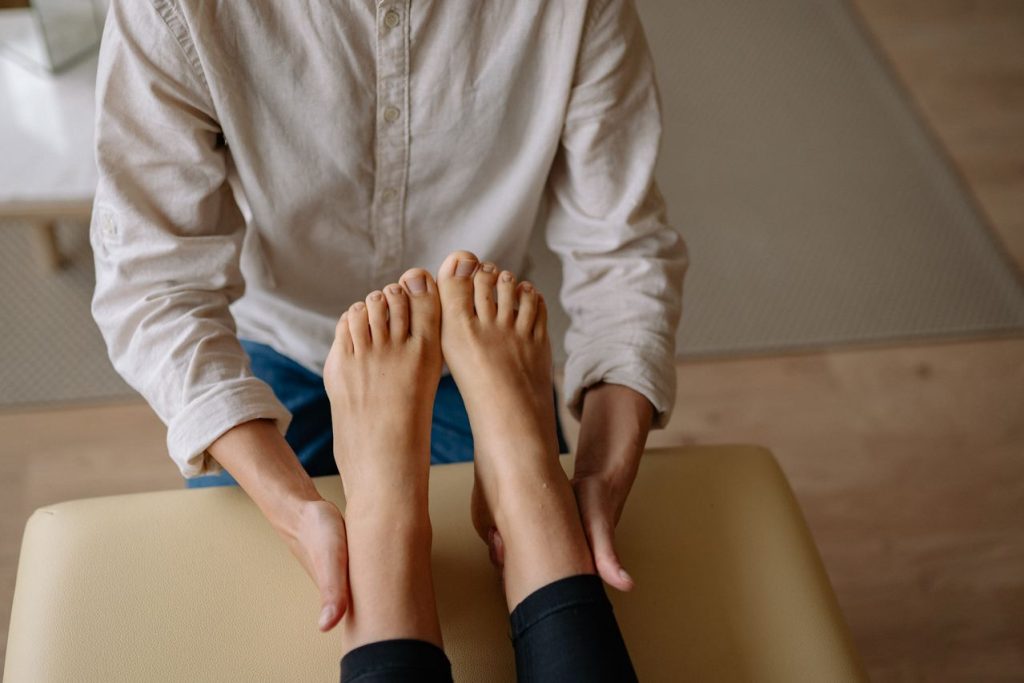
Why Does Neuropathy Make My Feet So Sensitive to Touch?
Not Sure Where to Start?
Choose the description that sounds most like what you’re experiencing:
🔥 My feet burn → Why Do My Feet Burn at Night?
👣 My feet or toes are numb → What Causes Numbness in My Toes?
🔥🧊 My feet are numb but still hurt → Why Do My Feet Hurt Even Though They Feel Numb?
🧦 It feels like I’m wearing socks when I’m barefoot → Why Do My Feet Feel Like They’re Wearing Socks When I’m Barefoot?
🌙 My symptoms are worse at night → Why Is My Peripheral Neuropathy Worse at Night?
🛏️ Even bedsheets touching my feet can hurt → You’re in the right place. Keep reading.
What You’ll Learn
In this chapter you’ll discover:
- Why neuropathy can make light touch painful
- What allodynia means
- What hyperalgesia means
- Why small nerve fibers are often involved in painful neuropathy
- Why bedsheets, socks, and shoes may become uncomfortable
- How someone can be numb and hypersensitive at the same time
- Why pain can become amplified by the nervous system
- Why symptoms may feel worse at night
- Whether hypersensitivity means your neuropathy is worsening
- What other conditions can cause extreme skin sensitivity
- Practical ways to reduce irritation
- When hypersensitivity deserves additional evaluation
Quick Answer
Peripheral neuropathy can make normally harmless touch feel painful because damaged or dysfunctional nerves may send abnormal signals to the spinal cord and brain.
A light touch that should register as:
“Something touched my foot”
may instead be interpreted as:
“That hurts.”
This phenomenon is called:
Allodynia
Another related problem is:
Hyperalgesia
which means a painful stimulus produces an unusually intense pain response.
These symptoms can occur with certain painful neuropathies, particularly when small sensory nerve fibers are involved.
The problem isn’t necessarily that the touch is too strong. The nervous system may be responding too strongly to the touch.
What Is Allodynia?
Allodynia means that something that normally should not cause pain becomes painful.
Examples might include pain from:
- Bedsheets touching the toes
- Socks rubbing against the feet
- Pants touching the lower legs
- A light brush of the skin
- A spouse gently touching the foot
- Water from a shower hitting the skin
These sensations can be extremely frustrating because the amount of physical contact seems far too small to explain the amount of pain.
But the pain can be very real.
What Is Hyperalgesia?
Hyperalgesia is different.
It means something that normally would hurt—
hurts much more than expected.
For example, something mildly painful may produce a disproportionately intense pain response.
A simple way to remember the difference is:
Allodynia
Something that shouldn’t hurt does hurt.
Hyperalgesia
Something that should hurt a little hurts much more than expected.
Both involve altered pain processing.
Why Would Neuropathy Cause This?
Your nervous system is designed to detect potential danger.
Pain helps protect you.
If you step on something sharp, pain tells you:
Move your foot.
If something is dangerously hot:
Pull away.
This warning system is extremely valuable.
But damaged sensory nerves can sometimes become unreliable.
Instead of accurately reporting what is happening, they may send:
- Abnormal signals
- Exaggerated signals
- Spontaneous signals
The nervous system may begin treating harmless stimulation as though it were threatening.
Think of It Like a Smoke Detector That’s Too Sensitive
A good smoke detector should sound when there’s smoke.
Imagine one that becomes so sensitive that it sounds when you:
- Make toast
- Boil water
- Open the bathroom door after a shower
The alarm is real.
But the trigger doesn’t match the intensity of the response.
Painful neuropathy can sometimes behave similarly.
The nervous system’s alarm system becomes overly responsive.
Small Nerve Fibers and Pain
Small sensory nerve fibers play an important role in detecting:
- Pain
- Temperature
When these fibers become dysfunctional, patients may experience:
- Burning
- Stinging
- Pins and needles
- Electrical sensations
- Abnormal heat or cold sensations
- Pain from light touch
This is one reason small fiber neuropathy may be associated with significant pain and hypersensitivity.
Can Small Fiber Neuropathy Cause Severe Pain Even With a Normal EMG?
Yes.
This is an important concept.
Routine nerve-conduction studies and EMG primarily evaluate larger nerve fibers and motor function.
Small nerve fibers aren’t assessed as directly by those routine studies.
So a patient can have:
- Burning feet
- Temperature abnormalities
- Allodynia
- Significant pain
and still have routine nerve-conduction testing that doesn’t demonstrate a typical large-fiber neuropathy.
A normal EMG does not automatically mean:
“Nothing is wrong with your nerves.”
How Can My Feet Be Numb and Too Sensitive at the Same Time?
This was the focus of our previous Learning Center article, and it deserves repeating.
Different nerve fibers carry different kinds of sensory information.
Neuropathy can reduce certain normal signals while producing abnormal pain signals.
That means the same foot may be:
Numb to normal touch
yet
Painful when lightly brushed.
It sounds impossible until you understand that the nervous system isn’t a single on/off wire.
Why Do Bedsheets Hurt?
This is one of the classic descriptions patients give.
They say:
“I can walk around during the day, but when I get into bed, I can’t stand the sheets touching my toes.”
Several things may contribute:
- Small-fiber dysfunction
- Allodynia
- Increased awareness at night
- Fewer competing sensory distractions
- Skin sensitivity
- Pressure or friction from bedding
The sheet hasn’t suddenly become harmful.
The nervous system’s interpretation of that contact has changed.
Why Does It Often Seem Worse at Night?
During the day, your brain is processing:
- Conversations
- Movement
- Work
- Driving
- Visual information
- Sounds
- Thousands of other sensory inputs
At night, much of that disappears.
The room becomes quiet.
You stop moving.
Attention shifts toward internal sensations.
That can make neuropathic symptoms feel much more prominent.
It does not necessarily mean more nerve damage is occurring at night.
Can Socks Become Painful?
Yes.
A sock may create:
- Light pressure
- Friction
- Warmth
- Contact with sensitive skin
For someone with allodynia, those normal sensations can become uncomfortable or painful.
But before blaming neuropathy, inspect the sock and foot.
Look for:
- Tight bands
- Bunched material
- Rough seams
- Skin irritation
- Swelling
- Pressure marks
Sometimes the sock really is contributing.
What About Shoes?
The same principle applies.
Neuropathy may make normal shoe contact uncomfortable.
But shoe pain should never automatically be dismissed as:
“Just neuropathy.”
Check for:
- Improper fit
- Narrow toe box
- Rough seams
- Foreign objects
- Pressure points
- Foot deformity
- Swelling
- Calluses
- Blisters
- Wounds
A painful nervous system and a poorly fitting shoe can exist at the same time.
Why Foot Inspection Is Still Important
This creates an unusual situation.
A neuropathy patient may have:
Too much pain from harmless touch
while simultaneously having:
Too little warning from actual injury.
That’s why you cannot judge foot safety by pain alone.
Inspect your feet.
Look for:
- Redness
- Blisters
- Cuts
- Cracks
- Calluses
- Swelling
- Drainage
- Open wounds
Pain does not guarantee normal protective sensation.
Can Shower Water Hurt?
Some patients with painful neuropathy find that water striking the skin feels uncomfortable.
Others become unusually sensitive to:
- Warm water
- Cool water
- Temperature changes
This may occur when small fibers responsible for pain and temperature sensation are affected.
However, reduced temperature sensation can also occur.
That creates a safety issue.
A person may experience abnormal temperature sensations while still being unable to accurately judge whether water is dangerously hot.
Be Careful With Hot Water
People with painful feet sometimes soak them in very hot water because warmth temporarily feels soothing.
But neuropathy can impair temperature discrimination.
Always avoid excessive heat.
The same warning applies to:
- Heating pads
- Hot-water bottles
- Space heaters
- Heated foot devices
- Hot pavement
A painful foot can still sustain an unnoticed burn.
What About Cold?
Some patients find cool temperatures soothing.
Others find cold extremely painful.
Again, responses vary because neuropathy affects people differently.
Extreme cold can also damage tissue.
The goal is comfort without creating another injury.
Can Touch Sensitivity Spread Up the Legs?
Yes, depending on the type and progression of neuropathy.
Many length-dependent neuropathies begin in the toes and feet.
As more nerve fibers become involved, symptoms may gradually extend upward.
Patients may eventually describe symptoms in:
- Ankles
- Lower legs
- Hands
But rapidly spreading symptoms deserve evaluation rather than simply assuming they represent ordinary neuropathy progression.
Does Hypersensitivity Mean My Nerves Are Getting Worse?
Not necessarily.
Changes in neuropathic pain do not perfectly measure the amount of nerve damage.
Symptoms can fluctuate.
They may be affected by:
- Sleep
- Stress
- Activity
- Temperature
- Blood glucose
- Illness
- Medications
- Other factors
Increasing pain deserves attention, particularly if accompanied by new neurological changes.
But more pain does not automatically equal more nerve destruction.
Can Stress Make Neuropathic Pain Feel Worse?
Yes, stress can influence how strongly pain is experienced.
That does not mean the pain is psychological or imaginary.
Pain is influenced by a complex interaction involving:
- Peripheral nerves
- Spinal cord
- Brain
- Sleep
- Mood
- Attention
- Stress responses
A real nerve injury can feel worse during periods of:
- Poor sleep
- Anxiety
- Illness
- Emotional stress
Understanding that relationship can help patients without dismissing the biological problem.
What Is Sensitization?
When pain pathways become more responsive than normal, the nervous system may become:
Sensitized
This can occur at different levels of the nervous system.
The result may be an exaggerated response to sensory input.
This helps explain why simply telling someone:
“Nothing is touching you hard enough to hurt”
isn’t helpful.
The physical stimulus may be mild.
The neurological response may not be.
Could Something Other Than Neuropathy Cause Skin Sensitivity?
Yes.
Painful skin sensitivity may have other causes, including:
- Shingles
- Nerve-root irritation
- Local nerve compression
- Skin disease
- Infection
- Inflammation
- Injury
- Complex regional pain syndrome
- Other neurological conditions
The pattern matters.
For example, sudden severe sensitivity on one side of the body followed by a blistering rash may suggest shingles rather than generalized peripheral neuropathy.
What If My Skin Hurts but Looks Normal?
Neuropathic pain can occur without:
- Redness
- Swelling
- Bruising
- Visible injury
The skin may look completely normal.
That can be frustrating because other people may not understand why it hurts.
But nerves are microscopic structures.
Nerve dysfunction doesn’t have to produce a visible skin change.
What If My Foot Is Red, Hot, or Swollen?
That’s different.
Do not automatically attribute visible changes to neuropathy.
A red, hot, swollen foot may indicate problems such as:
- Infection
- Injury
- Gout
- Charcot neuroarthropathy
- Vascular problems
- Other inflammatory conditions
Those changes deserve appropriate medical evaluation.
What Can I Do About Pain From Bedsheets?
Some practical adjustments may help certain patients.
Consider:
- Lightweight bedding
- Looser sheets
- Keeping heavy blankets off sensitive toes
- Changing foot position
- Soft, properly fitting socks if comfortable
- Adjusting room temperature
Some people use a bed cradle or similar device that keeps bedding from resting directly on the feet.
The goal is to reduce unnecessary contact while still maintaining a safe sleeping environment.
Should I Stop Wearing Socks?
Not necessarily.
Socks also help protect the feet.
Instead, look for socks that:
- Fit properly
- Don’t bunch
- Don’t create excessive pressure
- Have comfortable seams
- Work well with your shoes
The goal is not simply eliminating sensation.
It is reducing irritating stimulation while protecting the foot.
What About Desensitization?
In selected situations, healthcare or rehabilitation professionals may use carefully graded sensory exposure or desensitization strategies.
The concept is to expose the nervous system gradually to tolerable sensory input rather than overwhelming it.
But this should be individualized.
Aggressively rubbing or stimulating a severely painful foot isn’t automatically helpful and may make symptoms worse.
Can Exercise Help?
Appropriate physical activity may support:
- Circulation
- Strength
- Balance
- Mobility
- Metabolic health
- Sleep
- Overall function
But exercise should be matched to:
- Foot sensation
- Balance
- Strength
- Fall risk
- Foot condition
- Underlying cause
Someone with an open foot wound, severe instability, or significant weakness may require a modified plan.
What About Pain Medications?
Several prescription medications are used for neuropathic pain.
Which medication is appropriate depends on the patient, other medical conditions, medications, age, kidney function, fall risk, and the nature of the pain.
Some medications can cause:
- Drowsiness
- Dizziness
- Balance problems
So treatment should consider more than pain relief alone.
What About Topical Treatments?
Certain topical treatments may be used for selected types of neuropathic pain.
But even topical products should be used thoughtfully.
If sensation is reduced:
- Inspect the skin
- Follow instructions
- Avoid damaged skin unless specifically directed
- Watch for irritation
And remember:
A product that reduces pain does not necessarily repair the underlying nerve damage.
How We Evaluate Touch Sensitivity at Advanced Integrated Medical
When someone tells me:
“I can’t stand anything touching my feet,”
I want to know:
- Is the pain burning?
- Stinging?
- Electrical?
- Is light touch painful?
- Are the feet numb too?
- Are both feet affected?
- Did symptoms begin in the toes?
- Is one side dramatically worse?
- Can you feel hot and cold normally?
- Does the skin look normal?
- Are there wounds?
- Are there color changes?
- Is there swelling?
- Are the hands becoming sensitive?
- Is balance changing?
- Do you have diabetes?
- Could medications be contributing?
- Could this be small fiber neuropathy?
- Is another neurological condition possible?
The goal is to understand both the symptom and the pattern.
Treatment Depends on the Cause
Treatment for painful hypersensitivity depends on why it is happening.
Possible components may include:
- Treating the underlying cause of neuropathy
- Improving diabetes management when appropriate
- Correcting documented deficiencies
- Reviewing medications
- Neuropathic pain management
- Appropriate topical treatment
- Sleep strategies
- Footwear modification
- Reducing irritating pressure
- Rehabilitation when appropriate
- Foot protection
There is no single treatment that works for everyone.
About Dr. Dee
Dr. D. Scott (“Dee”) Stevens has spent nearly four decades helping patients with peripheral neuropathy, chronic pain, musculoskeletal disorders, sports injuries, and regenerative medicine.
Throughout his career, he has cared for patients from all walks of life—including professional, collegiate, and Olympic athletes, professional football players, Major League Baseball players, professional boxers, and MMA fighters.
One of the most important things patients have taught me is never to decide how much something hurts based on how harmless it looks.
A bedsheet doesn’t look dangerous.
A sock doesn’t look dangerous.
A gentle touch doesn’t look dangerous.
But when sensory nerves are malfunctioning, the nervous system may respond very differently than we expect.
The patient’s experience matters.
Dr. Dee’s Clinical Pearl
When a patient says:
“Even the sheets hurt my feet,”
don’t dismiss that statement because the sheet isn’t capable of injuring the foot.
Instead ask:
“Why is the nervous system interpreting harmless touch as pain?”
That question moves us away from judging the symptom—
and toward understanding it.
Dr. Dee’s Office Conversation
Patient: “Doctor, this sounds ridiculous, but I can’t stand the sheets touching my feet.”
Dr. Dee: “It doesn’t sound ridiculous.”
Patient: “But they’re just sheets.”
Dr. Dee: “Exactly. A sheet shouldn’t hurt. When harmless touch becomes painful, that gives us useful information about how your sensory nerves may be functioning.”
Patient: “So there’s actually a name for it?”
Dr. Dee: “Yes. We call that allodynia.”
Facing One of the Biggest Fears
“If My Feet Are This Sensitive, Does That Mean My Neuropathy Is Becoming Severe?”
Not necessarily.
Pain intensity doesn’t perfectly measure nerve damage.
Some people with severe sensory loss have very little pain.
Other people with painful small-fiber dysfunction may have intense burning and hypersensitivity.
Instead of judging severity by pain alone, evaluate:
- Sensation
- Strength
- Balance
- Function
- Distribution
- Rate of change
- Underlying cause
How loudly the nerves complain doesn’t always tell us how much function they’ve lost.
Patient Success Principle #31
Don’t Apologize for Describing a Strange Sensation
Patients frequently tell me:
“This is going to sound weird.”
Then they describe exactly what I need to hear.
Burning.
Freezing.
Invisible socks.
Walking on rocks.
Electrical shocks.
Pain from sheets.
Don’t edit your symptoms because you’re worried they sound strange.
Your description may be one of the most useful parts of the examination.
Tell us what it actually feels like.
Ask Dr. Dee
“Doctor, if light touch hurts, should I avoid anything touching my feet?”
Not necessarily.
We want to reduce unnecessary painful stimulation while still protecting the feet and maintaining function.
For example, lighter bedding may help at night.
Properly fitting socks and shoes may still be important for protection.
The goal is not to hide the feet from every sensation.
It’s to reduce irritation safely while we investigate and manage the underlying problem.
Lesson I’ve Learned in Nearly 40 Years
Never Tell a Patient What They Shouldn’t Be Feeling
A healthcare provider may look at the foot and see:
No swelling.
No bruise.
No cut.
No obvious injury.
But the patient says:
“It burns when you touch it.”
After nearly four decades, I’ve learned that the absence of something visible doesn’t mean the absence of something real.
You can’t see neuropathy by looking at the skin.
Listen to the patient.
Examine the nervous system.
Then ask why.
The Hope Principle
Living with painful hypersensitivity can be exhausting.
Patients may begin avoiding:
- Shoes
- Socks
- Bedding
- Walking
- Sleep
- Physical contact
The nervous system can begin to feel like an enemy.
But understanding what is happening changes the conversation.
Instead of:
“Why does everything hurt?”
we can begin asking:
What nerve fibers are involved?
What is causing the neuropathy?
What can reduce unnecessary irritation?
How can we protect the feet?
How can we improve sleep and function?
Not every painful nerve completely recovers.
But pain can sometimes be better managed, underlying contributors may be addressed, and function can often be protected.
Hope begins when a strange symptom finally starts making sense.
“I believe the best healthcare decisions are made when patients understand their condition. My job isn’t simply to treat symptoms—it’s to help you understand why they’re happening and what your options are.”
— Dr. D. Scott (“Dee”) Stevens
Frequently Asked Questions
Why does neuropathy make my feet hurt when they’re touched?
Damaged or dysfunctional sensory nerves may cause harmless touch to be interpreted as painful. This is called allodynia.
What is allodynia?
Allodynia is pain caused by a stimulus that normally should not be painful, such as light touch from bedsheets or clothing.
What is hyperalgesia?
Hyperalgesia means an ordinarily painful stimulus produces a greater-than-expected pain response.
Why do bedsheets hurt my feet?
Painful neuropathy, particularly small-fiber dysfunction, may make light touch uncomfortable or painful. Nighttime attention and reduced distractions may make symptoms more noticeable.
Can my feet be numb and hypersensitive at the same time?
Yes. Different nerve fibers carry different sensory signals, so normal sensation may be reduced while abnormal pain signals remain or become exaggerated.
Can small fiber neuropathy cause touch sensitivity?
Yes. Small fibers carry pain and temperature information and can be involved in burning, stinging, allodynia, and other painful sensations.
Can I have small fiber neuropathy with a normal EMG?
Yes. Routine EMG and nerve-conduction testing primarily evaluate larger nerve fibers and may be normal in isolated small fiber neuropathy.
Does severe touch sensitivity mean my neuropathy is getting worse?
Not necessarily. Pain intensity does not perfectly correspond with nerve damage or progression.
Should I stop wearing shoes and socks if they hurt?
Not automatically. Feet with reduced sensation still need protection. The better approach is often to evaluate fit, seams, pressure, swelling, and footwear design.
Why should I inspect painful feet?
Because neuropathic pain does not guarantee normal protective sensation. A foot can hurt intensely and still fail to adequately detect an injury.
Key Takeaways
- Neuropathy can make normally harmless touch painful.
- Pain from harmless touch is called allodynia.
- An exaggerated response to painful stimulation is called hyperalgesia.
- Small sensory nerve fibers play an important role in pain and temperature.
- Small fiber neuropathy can sometimes exist despite normal routine EMG and nerve-conduction testing.
- Numbness and hypersensitivity can occur in the same foot.
- Bedsheets, socks, shoes, water, and light touch may become painful.
- Severe pain does not automatically mean severe nerve loss or progression.
- Painful feet may still have reduced protective sensation.
- Foot inspection remains important.
- Visible redness, swelling, wounds, or other changes should not automatically be blamed on neuropathy.
- Don’t apologize for describing a strange sensation.
Why Patients Choose Advanced Integrated Medical
At Advanced Integrated Medical, if you tell us:
“Even my bedsheets hurt,”
we don’t dismiss it.
We want to know:
What kind of pain is it?
Where does it occur?
Are the feet numb too?
Can you feel temperature normally?
Is light touch painful?
Are both feet involved?
Is the skin changing?
Could small nerve fibers be involved?
What may be causing the nerve dysfunction?
Because sometimes one unusual sentence from a patient tells us more than a long list of medical terms.
Continue Exploring the Learning Center
You may also want to read:
- Why Do My Feet Hurt Even Though They Feel Numb?
- Why Do My Feet Burn at Night?
- What Is Small Fiber Neuropathy?
- Why Is My Peripheral Neuropathy Worse at Night?
- Can Peripheral Neuropathy Affect My Sleep?
- What Causes Numbness in My Toes?
- Why Are My Feet Cold Even When They Feel Warm?
- What Shoes Are Best for Peripheral Neuropathy?
- How Do I Know If My Peripheral Neuropathy Is Getting Better?
- I’ve Been Diagnosed With Peripheral Neuropathy—What Should I Do Next?
Medical Disclaimer
This article is intended for educational purposes only and is not a substitute for individualized medical diagnosis or treatment.
Painful skin sensitivity can have many causes, including peripheral neuropathy, small fiber neuropathy, nerve compression, shingles, injury, skin disease, infection, inflammatory disorders, and other neurological conditions.
Seek prompt medical evaluation for new or rapidly worsening pain, significant weakness, new foot drop, rapidly spreading symptoms, an open wound, increasing redness, warmth, swelling, drainage, fever, or a major change in one foot or leg.
Sudden one-sided weakness or numbness, facial drooping, speech difficulty, or other possible stroke symptoms require emergency medical care.
Use caution with heating pads, hot-water bottles, hot foot baths, heated foot devices, or extreme cold when sensation is impaired because neuropathy can reduce your ability to recognize tissue-damaging temperatures.
Ready to Learn More?
If your feet hurt when something as light as a bedsheet touches them, don’t assume:
“This makes no sense.”
Instead ask:
Is this allodynia?
Could small nerve fibers be involved?
Why are my nerves responding this way?
What caused the nerve dysfunction?
How much protective sensation do I still have?
How can I reduce irritation without leaving my feet unprotected?
At Advanced Integrated Medical, we believe strange symptoms often become less frightening once patients understand why they happen.
Because when a bedsheet hurts, the important question isn’t:
“How can a sheet cause that much pain?”
The better question is:
“Why is my nervous system interpreting something harmless as painful?”